99 years and 364 days ago, the approximately 2200 people aboard the RMS Titanic were four days into their trans-Atlantic voyage from Southampton to New York City and having a grand old time. That all changed the night of April 14, 1912, when an iceberg tore open her starboard side, and the unthinkable happened. Within just two and a half hours, in the early morning hours of April 15, the “unsinkable” ship had cataclysmically broken apart and plummeted to a watery grave 12,540 feet below. And the rest, as they say, is history.
* * *
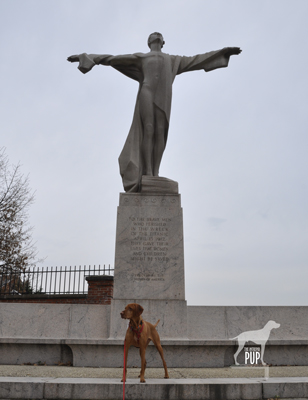
Fast forward to a few weeks ago on the Washington, DC waterfront. An early twenty-somethings couple was sitting on the wall of the Titanic Memorial when we approached. Intrigued by the fact that Tavish the Intrepid Pup was being photographed, the young woman in the duo struck up a conversation and inquired about Tavish. Upon explaining to her that this was the latest monument in a growing list of ones he’s visited, she seemed thoughtful. “Hmm,” she said, “the Titanic. Yeah. I saw the movie.” And then, a few moments later: “So, what’s up with this memorial, anyway? Did the Titanic sink here?”
Aside from the egregious incongruity of her remark, she had actually made a good point: why is there a Titanic Memorial in Washington, DC? The Titanic most assuredly did not strike an iceberg in the nation’s capital, and DC’s Southwest Waterfront couldn’t look any less like the cold expanse of the North Atlantic. Indeed, there are other places with far more direct connections to the Titanic, like Belfast, where the ocean liner was built, or Fairview Lawn Cemetery in Halifax, where 121 of the victims are interred.
The reason, quite simply, is that a group of wealthy women, the Women’s Titanic Memorial Association, raised the funds in response to congressional authorization of a national monument. The winning design selected by the Fine Arts Commission consisted of a robed male figure designed by Gertrude Vanderbilt Whitney (1875-1942, of Whitney Museum of Art fame) standing amidst a granite exedra designed by architect Henry Bacon (1866-1924, of Lincoln Memorial fame). The memorial was completed in 1918, but it wasn’t until 1931 that it was installed and dedicated at the intersection of New Hampshire Avenue, NW and Rock Creek Parkway, on the riverbank. The base of the sculpture bears the inscription:
TO THE BRAVE MEN
WHO PERISHED
IN THE WRECK
OF THE TITANIC
APRIL15, 1912
THEY GAVE THEIR
LIVES THAT WOMEN
AND CHILDREN
MIGHT BE SAVED
Erected by the Women of America
Kirk Savage’s compelling book Monument Wars (University of California Press, 2009) includes a 1936 photograph of the memorial at this location, partially and disturbingly submerged during Potomac River flooding. In 1968 the memorial was relocated to its present location on the southwest waterfront near Fort McNair, as it had been removed two years before to make way for construction of the Kennedy Center for the Performing Arts.
In departing the Titanic Memorial and continuing our walk along the waterfront that afternoon, we encountered an older woman and her dog. We exchanged pleasantries and learned that she lived in the nearby Riverside Condominium complex. She’d observed that we’d come from the memorial and offhandedly remarked, “You know about the men in tuxedos, don’t you?” With a sly smile, she then launched into a seemingly apocryphal eyewitness account of a group of men who, since 1979, appear every year on April 15th at 12:30 a.m., dressed in formal wear, to place flowers at the memorial and offer up a champagne toast to the men who’d sacrificed their lives. Haunting, but—as it turns out—absolutely true. The tuxedoed group is none other than the Men’s Titanic Society, which started out as a group of friends who wanted to honor the spirit and intent of what they saw as a forgotten memorial.
Though the DC memorial may have fallen off the public’s radar, the Titanic itself never did. In this 100th anniversary year, towns and museums far and wide are leveraging any Titanic connection they have, whether it’s a hometown family lost in the tragedy or a single artifact. And while this list is not exhaustive, there are currently substantive Titanic-related exhibits at the Maritime Museum of the Atlantic, Mystic Aquarium, National Geographic Museum, Titanic Belfast, Widener University Art Gallery, and Woods Hole Oceanographic Institution’s Ocean Science Exhibit Center. RMS Titanic, Inc., the company that controversially conducted salvage operations on the wreck site, has Titanic: The Artifact Exhibition on view at 8 distinct venues throughout the country, including a semi-permanent installation at the Luxor in Las Vegas. Separately, there are permanent Titanic Museum Attractions in Branson, Missouri, and Pigeon Forge, Tennessee. Alas, you’re too late to join the “Titanic Memorial Cruise” of the MS Balmoral that’s already underway, but you can catch the re-release of James Cameron’s 1997 film “Titanic” in 3D. Or you can read National Geographic’s newly-published e-book single about the Titanic. Prefer television? You have your choice this week of a History Channel documentary, two National Geographic specials, or an ABC mini-series. It all adds up to a somewhat macabre fascination of, well, titanic proportions. Why does the Titanic story still resonate after 100 years? For one, the Titanic was a cruise ship, and we still have those. It’s not an abstraction in the way that, say, a sunken 17th-century galleon might be. Secondly, in the grand scheme of things, 100 years isn’t really that long ago. The last survivor from the Titanic only died in 2009. There are people alive today who can tell of grandparents and great-grandparents aboard the ill-fated ship. One can relate, and the stories are all the more palpable. Third, positively identifying the wreck site in 1985 reignited interest and gave tantalizing hope to those seeking answers to Titanic’s multitude of unanswered questions. Your author (and one half of Team Tavish) grew up in the community that’s home to Woods Hole Oceanographic Institution (WHOI), the entity that backed the fabled 1985 exploratory expedition of Bob Ballard and crew. The frisson of excitement that rippled ’round the world upon the discovery of the Titanic was amplified locally; not only was the news historic, but also chances were you that your neighbor, your dad, or your friend’s parent had somehow been involved with the effort. Finally, when the Titanic sank, it violently intruded upon a cold and inhospitable world, introducing humanity—people, lifetimes, names, memories—where none had previously existed. This alone will be what perpetuates the Titanic’s legacy another 100 years.
Dogging the Details 38°52′18.90″N, 77° 1′9.68″W
Titanic Memorial, Washington, DC
 The Titanic Memorial is located where P Street, SW dead-ends into the channel; once you’re in the vicinity, blue way-finding signs point you in the right direction. On a weekday, it’s pretty easy to find nearby parking either at meters by Arena Stage or in 2-hour spaces along 4th Street, SW. If traveling by Metrorail, the nearest stop is the Waterfront-SEU station at the intersection of M and 4th Streets, SW.
Visiting the memorial scores a “1” on the Intrepid Pup wag-a-meter for the easy, flat walk. The memorial is usually fairly deserted, although the Titanic 100th anniversary fanfare is bound to raise its profile. The Southwest DC Heritage Project is holding an elaborate TITANIC 100 commemorative event at the memorial on April 14, 2012. The program will feature 50-foot archival images projected onto a nearby building, luminaries lit in memory of the 1,500 people who died, and a live performance of “Nearer My God to Thee,” the last song that the Titanic’s onboard musicians played before the ship sank.
One final note on the subject of the Titanic: research into nearly every conceivable angle of the voyage continues to turn up the occasional new tidbit. Among the latest is that there were apparently 12 dogs aboard the Titanic; only 3 survived.
 It’s Opening Day for Major League Baseball 2012! For many, it signals a prelude to summer with baseball being the quintessential pastime, as American as Mom and apple pie. But did you know your dog can get a piece of the action, too? For the 2012 season, a record 16 MLB franchises are welcoming dogs to their ballparks as part of regular season, individual game promotions. Kudos to the Astros, Athletics, Braves, Cardinals, Dodgers, Giants, Indians, Marlins, Mets, Nationals, Padres, Pirates, Rangers, Reds, Royals, and White Sox for embracing dogs and dog lovers among their fan bases!


 Parking is ample, but fees directly correlate to proximity to the ballpark and can get pricey. The clear message here is to walk, bike (yes, there are numerous bike racks outside the stadium!), take Metro to the Navy Yard stop, board a bus, or hop a DC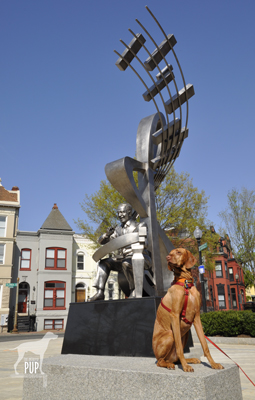



 With all the recent talk of feisty solar flares amping up the activity of the Northern Lights and having the potential to wreak a little havoc with power grids and GPS devices here on Earth, the Intrepid Pup turns his attentions to the firmament. And what better place to whet one’s celestial appetite than the
  If you’ve always associated Maine with craggy shorelines, there are plenty. But you might be surprised to learn that beautiful sandy beaches can be found in coastal towns throughout southern Maine. One favorite is Kennebunk Beach. At low tide, this crescent-shaped swath of sand extends out about a hundred yards before receding into the Atlantic Ocean. Then, if you could even see this far, the next land you’d spot would be Portugal. Seriously. The surrounding communities, collectively known as the Kennebunks, are tourist magnets (particularly in the summer and fall), but Kennebunk Beach holds a year-round allure even after temperatures for swimming and sun-bathing are but distant memories. The sidewalk follows the shoreline and is great for dog-walking, complete with several waste receptacles and doggie-bag dispensers. In fact, this same scenic route along the seawall is used by the area’s Animal Welfare Society for its insanely popular (and fun) annual “Strut Your Mutt” fundraiser.
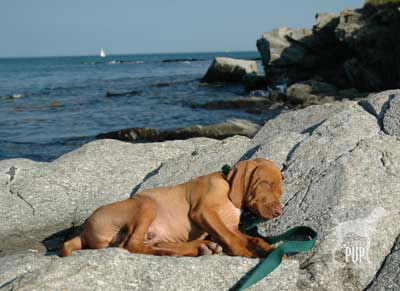 Team Tavish dug back into the Intrepid Pup archives for this pic of an approximately 11-week-old Tavish on one of his very first trips to what would become a frequent destination: Peaks Island. Of the several hundred island communities that dot Casco Bay, Peaks is the most populous with ~1,100 year-round residents, though that number swells to 4,000+ during the summer months. Peaks is actually part of the City of Portland, but its history has been punctuated by various—and as yet, unsuccessful—secessionist movements. It’s accessible via a 15-minute ride from downtown Portland on the Casco Bay Lines
 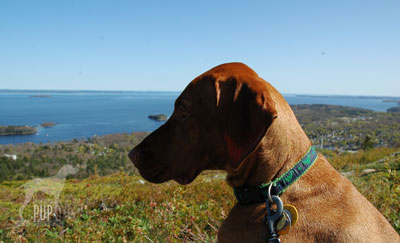 Camden
 A 1st grader peeped his head around the door, turned back to his classmates and proclaimed, “Hey! The dogs are here!”
 The classrooms were hives of activity. 130 kindergartners through 5th graders could barely contain their excitement. Tavish’s role, along with five other dogs, was to “help” with the final after-school activities of the day. Tables were cleared to make way for scissors, staplers, paper plates and construction paper. The result? “Cat in the Hat” hats, of course! And then, armed with Dr. Seuss bookmarks, there was the chance to choose from an array of Dr. Seuss storybooks. Grinning from ear to ear, young Cheyenne
 February is
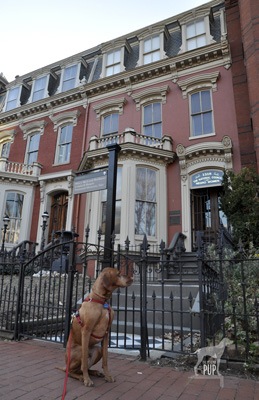
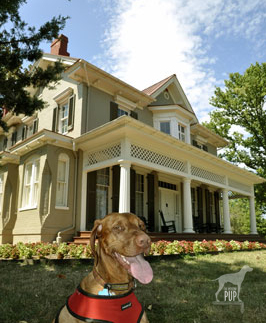
 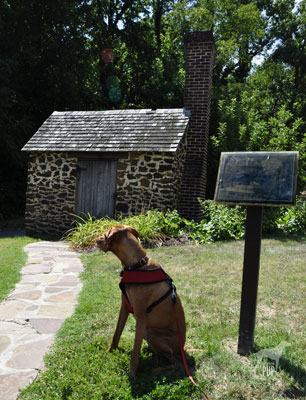 On the day of our visit, we had an exceptionally knowledgeable and engaging young ranger. He deftly hit the highlights of Douglass’s public life but also gave insights into Douglass’s more personal side, pointing out Douglass’s extensive library, the violin he played, and the free weights he used to maintain his personal fitness. Referencing the various portraits throughout the house, the park ranger expounded upon Douglass’s social circle and relationships with abolitionists William Lloyd Garrison and John Brown; Presidents Lincoln, Grant, Hayes and Harrison; Underground Railroad champion Harriet Tubman; and abolitionist and suffragist Elizabeth Cady Stanton. He explained the importance of Douglass’s family life and—after wife Anne’s death in 1882—controversial second marriage in 1884 to Helen Pitts, a white woman and women’s rights activist and publisher. And we learned-lesser known details, such as Douglass’s appointments as Charge’ d’Affaires for Santo Domingo and as Minister to Haiti. Before departing, we checked out the rustic outbuilding at the rear of the property. It’s a reconstruction of Douglass’ self-proclaimed “Growlery.” Evocative of a lion’s lair, it served as Douglass’ personal retreat for writing and study.