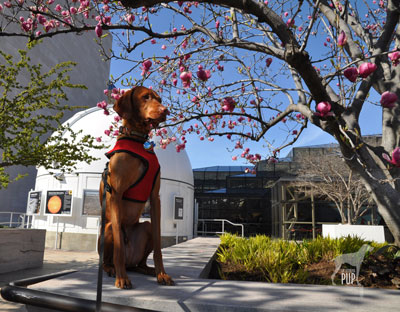
 With all the recent talk of feisty solar flares amping up the activity of the Northern Lights and having the potential to wreak a little havoc with power grids and GPS devices here on Earth, the Intrepid Pup turns his attentions to the firmament. And what better place to whet one’s celestial appetite than the Smithsonian’s National Air and Space Museum?
Except…we’re directing your attention not to the museum’s exhibition galleries that are literally among the most visited in the world but rather to its lesser-known but not-so-little nub of an astronomical observatory that rests upon the museum’s outdoor east terrace right on Washington, DC’s National Mall.
The Public Observatory Project (POP) is the tangible manifestation of a dream long-held by Dr. David DeVorkin, the museum’s senior curator of astronomy and space sciences. To know DeVorkin is also to know that he’s an enthusiastic proponent of making astronomy accessible. “The Mall has its monuments,” he wrote back in 2009, “What it needs is a portal, a portal to the universe.” The idea was to put a telescope where people—slews of them!—already are, thereby igniting interest in astronomy among casual observers. It didn’t quite take an act of Congress, but it did require a dedicated project team and approvals from the museum, the U.S. Commission of Fine Arts, and the National Capital Planning Commission. Dream became reality when the observatory opened in October 2009 to coincide with the International Year of Astronomy. The observatory’s workhorse is a 16-inch Boller & Chivens telescope re-purposed from Harvard-Smithsonian’s Oak Ridge Observatory in Massachusetts, but staffers also keep several smaller hand-held telescopes at the ready for visitors. The observatory is free and open to the public, though operating hours are highly weather dependent, so check POP’s Twitter feed for updates. For daytime viewing, you’ll be training the telescopes to look at moon craters, the phases of Venus, and yes,—with the aid of safe solar filters—sunspots! Now you can see for yourself what the sun is up to.
Dogging the Details
38°53′16.26″N, 77°1′6.67″W
Public Observatory, Smithsonian Institution’s National Air and Space Museum, Washington DC
 The observatory scores a “1” on the Wag-a-meter as it’s pretty darn accessible. Parking during the day can be problematic as there are no big public parking lots close by, but there are metered spaces along Independence Avenue and side streets, and the L’Enfant Plaza and Smithsonian Metro stations are both within easy walking distance.
Alas, your dog can’t hang out in the observatory and would likely have trouble peering through the telescope’s eyepiece even if he could. Yet if you’re out on a walk with your dog, there are informative panels to read on the observatory’s exterior, and when the observatory is open to visitors, astronomy educators are often right by the door and will gladly field your questions.
If you happen to go stargazing on one of POP’s special nighttime observation evenings, ask the staff if you can take a gander at Canis Major (a constellation representing one of the great hunter Orion’s dogs)…and tell them the Intrepid Pup sent you.
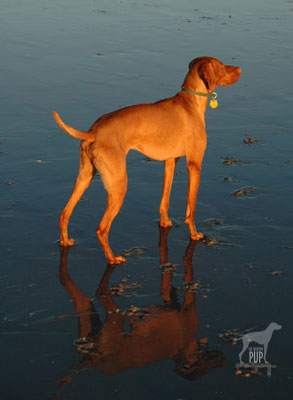 If you’ve always associated Maine with craggy shorelines, there are plenty. But you might be surprised to learn that beautiful sandy beaches can be found in coastal towns throughout southern Maine. One favorite is Kennebunk Beach. At low tide, this crescent-shaped swath of sand extends out about a hundred yards before receding into the Atlantic Ocean. Then, if you could even see this far, the next land you’d spot would be Portugal. Seriously. The surrounding communities, collectively known as the Kennebunks, are tourist magnets (particularly in the summer and fall), but Kennebunk Beach holds a year-round allure even after temperatures for swimming and sun-bathing are but distant memories. The sidewalk follows the shoreline and is great for dog-walking, complete with several waste receptacles and doggie-bag dispensers. In fact, this same scenic route along the seawall is used by the area’s Animal Welfare Society for its insanely popular (and fun) annual “Strut Your Mutt” fundraiser.
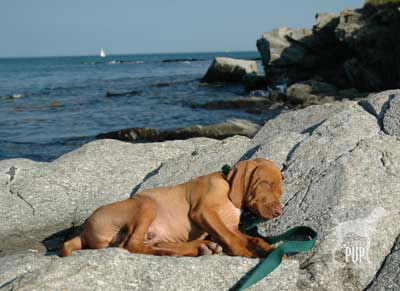 Team Tavish dug back into the Intrepid Pup archives for this pic of an approximately 11-week-old Tavish on one of his very first trips to what would become a frequent destination: Peaks Island. Of the several hundred island communities that dot Casco Bay, Peaks is the most populous with ~1,100 year-round residents, though that number swells to 4,000+ during the summer months. Peaks is actually part of the City of Portland, but its history has been punctuated by various—and as yet, unsuccessful—secessionist movements. It’s accessible via a 15-minute ride from downtown Portland on the Casco Bay Lines
 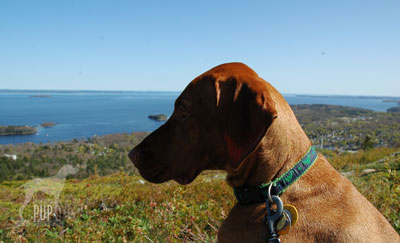 Camden
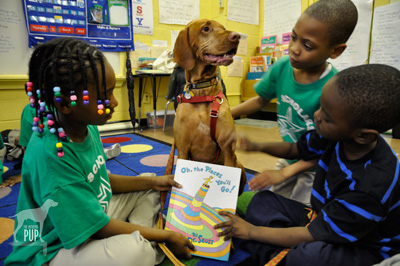 A 1st grader peeped his head around the door, turned back to his classmates and proclaimed, “Hey! The dogs are here!”
 The classrooms were hives of activity. 130 kindergartners through 5th graders could barely contain their excitement. Tavish’s role, along with five other dogs, was to “help” with the final after-school activities of the day. Tables were cleared to make way for scissors, staplers, paper plates and construction paper. The result? “Cat in the Hat” hats, of course! And then, armed with Dr. Seuss bookmarks, there was the chance to choose from an array of Dr. Seuss storybooks. Grinning from ear to ear, young Cheyenne
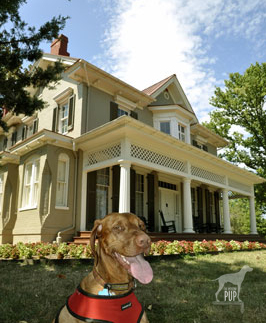 February is
 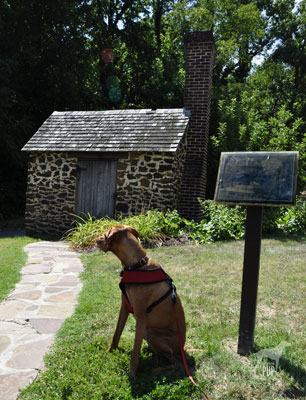 On the day of our visit, we had an exceptionally knowledgeable and engaging young ranger. He deftly hit the highlights of Douglass’s public life but also gave insights into Douglass’s more personal side, pointing out Douglass’s extensive library, the violin he played, and the free weights he used to maintain his personal fitness. Referencing the various portraits throughout the house, the park ranger expounded upon Douglass’s social circle and relationships with abolitionists William Lloyd Garrison and John Brown; Presidents Lincoln, Grant, Hayes and Harrison; Underground Railroad champion Harriet Tubman; and abolitionist and suffragist Elizabeth Cady Stanton. He explained the importance of Douglass’s family life and—after wife Anne’s death in 1882—controversial second marriage in 1884 to Helen Pitts, a white woman and women’s rights activist and publisher. And we learned-lesser known details, such as Douglass’s appointments as Charge’ d’Affaires for Santo Domingo and as Minister to Haiti. Before departing, we checked out the rustic outbuilding at the rear of the property. It’s a reconstruction of Douglass’ self-proclaimed “Growlery.” Evocative of a lion’s lair, it served as Douglass’ personal retreat for writing and study.