It’s April 16th. In the District of Columbia, kids have the day off from the school, and DC government offices are closed. A parade has concluded, but the street festival will continue, culminating in a fireworks display just a few hours from now. What’s the occasion? DC Emancipation Day: widely celebrated for years but only officially made a DC public holiday by Mayor Anthony Williams in 2005.
While Abraham Lincoln’s Emancipation Proclamation of January 1, 1863, is what always makes the cut to be on virtually any timeline of the American Civil War, the fact of the matter is that the emancipation of slaves really began 8 1/2 months earlier. Presented with the District of Columbia Compensated Emancipation Act—first introduced by Massachusetts senator Henry Wilson in December 1861—President Lincoln signed it into law on April 16, 1862. The stroke of his pen granted instant freedom to 3,100 slaves in the nation’s capital and ended the abhorrent anomaly that slaves could be bought and sold within sight of the very bastions of a federal government simultaneously struggling to save a divided nation at war. The “compensated” portion of the Act entailed the government remunerating slave owners loyal to the Union with up to $300 for each slave; the government ultimately paid out nearly $1 million through a process managed by a three-person Emancipation Commission. In addition, former slaves were offered a $100 incentive should they opt to emigrate from the country, namely to Liberia or Haiti.
Lincoln must have had some satisfaction in enacting the legislation, since he had long believed gradual, compensated emancipation to be viable option in trying to run the gauntlet between outright abolition and the all-important preservation of the Union. Yet, interestingly, the compensation factor so prevalent in the DC act did not carry over to the more sweeping Emancipation Proclamation.
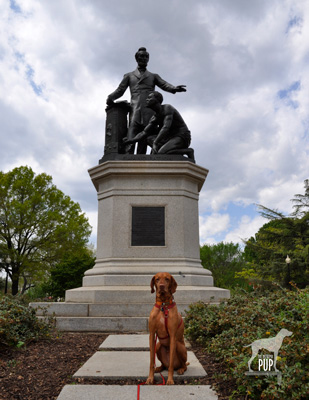
While the Freedmen’s Memorial Monument to Abraham Lincoln (pictured here during the Intrepid Pup’s recent visit) was actually erected in response to Lincoln’s Emancipation Proclamation of 1863, it’s equally relevant to remember it on today’s 150th anniversary of the DC Emancipation. Blocks from the Capitol Building in a park that was once the site of a Civil War hospital, the monument rises, a pedestal topped with a sculpture grouping designed by Thomas Ball (1819-1911). It depicts a newly-emancipated male slave kneeling before Abraham Lincoln. At the base, in capital letters, is the single word: EMANCIPATION. The memorial has been roundly criticized as reinforcing notions of paternalism, supplication and subservience. Indeed, the monument presents an image jarring to 21st-century sensibilities. As a run-up to this year’s 150th anniversary DC Emancipation festivities, the Washington Post just ran an article that included the Freedmen’s Memorial; one reader who’d grown up a stone’s throw from the park responded online, “I never liked that statue. Even as a child, I always thought they should be shaking hands.” But it’s also important to place the memorial within its historical context. As the plaque affixed to the rear of the monument reads:
Freedom’s Memorial
In grateful memory of Abraham LincolnThis monument was erected by the Western Sanitary Commission of Saint Louis MO:
with funds contributed solely by emancipated citizens of the United States declared free by his proclamation January 1st A.D. 1863.
The first contribution of five dollars was made by Charlotte Scott a freed woman of Virginia being her first earnings in freedom and consecrated by her suggestion and request on the day she heard of President Lincoln’s death to build a monument to his memory.
The monument was dedicated on April 14, 1876, the 11th anniversary of Lincoln’s assassination. Frederick Douglass gave the keynote address before a reported crowd of 25,000. It’s clear from his remarks that he thought of the statue much more as a memorial to Lincoln than as a monument to the act of emancipation, and privately he, too, apparently expressed disappointment at how the figures were portrayed. Then, as now, public art encourages exploration and invites discussion.
Dogging the Details
38°53′23.26″N, 76°59′24.76″W
Freedmen’s Memorial Monument to Abraham Lincoln, Lincoln Park, Washington, DC
 As noted in an earlier Intrepid Pup posting related to Lincoln Park, the site of this statue is exceptionally dog-friendly (earning it a “2” on the Intrepid Pup Wag-a-Meter), with many people using it as a de facto dog park. It’s important to mention, however, that this is not an officially-designated city dog park. Rather, it’s maintained by the National Park Service, and the expected rules of conduct apply (e.g. keep your dog under your personal control and clean up).
The park is located at 12th Street and Massachusetts Avenue, NE and an easy walk due east from the U.S. Capitol. If arriving by car on a weekday, it’s not difficult to find free 2-hour parking nearby along the residential side streets.
 February is
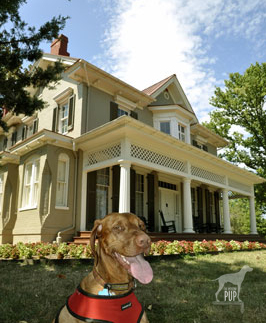
 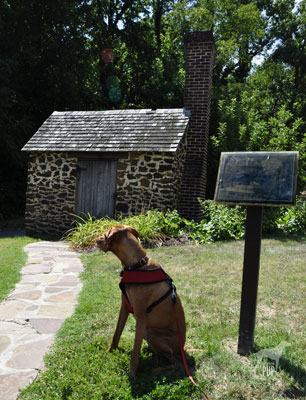 On the day of our visit, we had an exceptionally knowledgeable and engaging young ranger. He deftly hit the highlights of Douglass’s public life but also gave insights into Douglass’s more personal side, pointing out Douglass’s extensive library, the violin he played, and the free weights he used to maintain his personal fitness. Referencing the various portraits throughout the house, the park ranger expounded upon Douglass’s social circle and relationships with abolitionists William Lloyd Garrison and John Brown; Presidents Lincoln, Grant, Hayes and Harrison; Underground Railroad champion Harriet Tubman; and abolitionist and suffragist Elizabeth Cady Stanton. He explained the importance of Douglass’s family life and—after wife Anne’s death in 1882—controversial second marriage in 1884 to Helen Pitts, a white woman and women’s rights activist and publisher. And we learned-lesser known details, such as Douglass’s appointments as Charge’ d’Affaires for Santo Domingo and as Minister to Haiti. Before departing, we checked out the rustic outbuilding at the rear of the property. It’s a reconstruction of Douglass’ self-proclaimed “Growlery.” Evocative of a lion’s lair, it served as Douglass’ personal retreat for writing and study.